
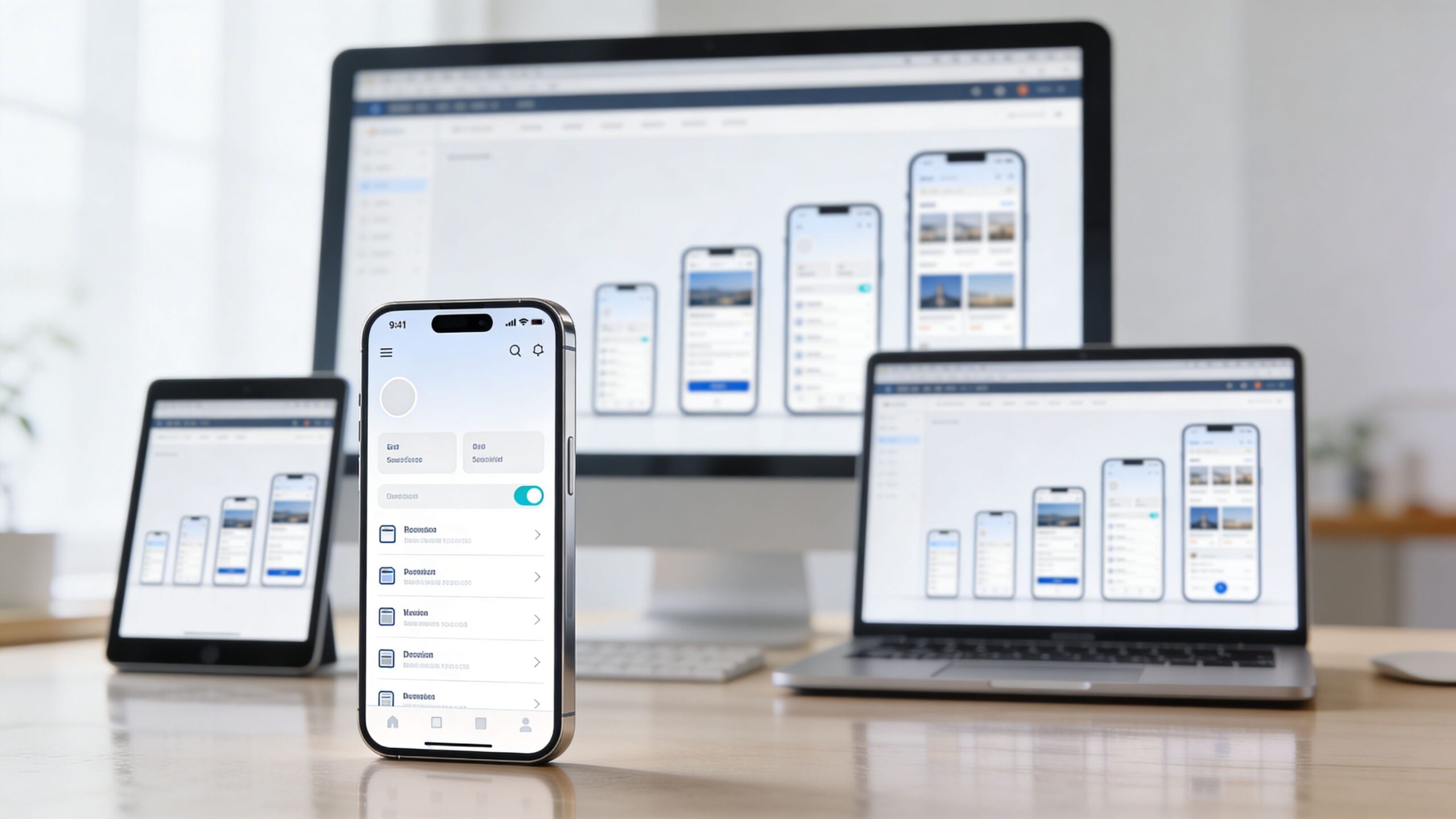
In today’s digital landscape, users expect seamless experiences no matter how they access a website. Whether browsing on a smartphone during a commute or navigating a desktop at work, the expectation is the same: fast, intuitive, and visually appealing interactions. This expectation has driven the evolution of modern web design strategies, with two dominant approaches emerging at the forefront—mobile-first design and responsive design. While these terms are often used interchangeably, they represent distinct philosophies and workflows. Understanding the difference between mobile-first design and responsive design is essential for anyone building or managing a website. Both aim to create adaptable, user-friendly experiences, but they approach the challenge from different starting points. By exploring how they differ, where they overlap, and when to use each, you can make smarter decisions that improve user experience, boost SEO performance, and future-proof your digital presence.
A: No; responsive design is the overall adaptation concept, while mobile-first is one way to build it.
A: They work together, but mobile-first often creates a cleaner process for modern websites with heavy phone traffic.
A: Yes; many sites are responsive but were originally designed desktop-first and adapted later.
A: It usually keeps base styles simpler and adds larger-screen enhancements only when needed.
A: They apply styles once the screen reaches a certain size, which fits a mobile-first workflow.
A: They apply styles below a certain width and are common in desktop-first approaches.
A: Not automatically; it depends on your theme, page builder, CSS, and how the site is structured.
A: No; it starts with phones, but the goal is still a strong experience across all screen sizes.
A: Assuming a layout is mobile-friendly just because it shrinks instead of testing readability, spacing, speed, and navigation.
A: Often yes, especially if mobile traffic is high or the current layout feels cramped and outdated on smaller screens.
Understanding Responsive Design from the Ground Up
Responsive design is one of the most widely adopted approaches in modern web development. At its core, it focuses on creating a single website that dynamically adjusts its layout based on the size and characteristics of the user’s screen. This flexibility is achieved through fluid grids, scalable images, and CSS media queries that apply different styles depending on the device.
Traditionally, responsive design has been implemented with a desktop-first mindset. Designers begin by creating a full-featured layout for larger screens, then use media queries to scale down and adapt the design for smaller devices like tablets and smartphones. Elements are rearranged, resized, or hidden to ensure usability across various screen sizes.
The strength of responsive design lies in its adaptability. It allows developers to maintain a single codebase while delivering a consistent experience across devices. However, starting from a desktop perspective can sometimes lead to challenges when translating complex layouts into smaller screens. Without careful optimization, mobile users may encounter slower load times or less intuitive navigation.
The Mobile-First Philosophy Explained
Mobile-first design flips the traditional process on its head. Instead of starting with a desktop layout, designers begin with the smallest screen in mind. The focus is on creating a streamlined, efficient experience for mobile users, then progressively enhancing the design for larger screens.
This approach aligns closely with how people use the internet today. With mobile devices accounting for the majority of web traffic, prioritizing mobile usability has become a logical and often necessary strategy. By starting small, designers are forced to focus on essential content and functionality, eliminating unnecessary elements that could clutter the experience.
As the design scales up, additional features and visual enhancements are introduced for larger screens. This progressive enhancement ensures that the core experience remains fast, accessible, and user-friendly on all devices. Mobile-first design is not just a technical approach—it’s a mindset that emphasizes simplicity, performance, and user-centric thinking.
Key Differences That Shape User Experience
Although mobile-first and responsive design share similar goals, their differences have a significant impact on how websites are built and experienced. One of the most important distinctions lies in the starting point. Responsive design often begins with a desktop layout and adapts downward, while mobile-first design starts with the smallest screen and builds upward.
This difference influences everything from layout structure to performance optimization. In a desktop-first responsive approach, designers may need to remove or simplify elements for mobile users, which can sometimes result in compromises. In contrast, mobile-first design ensures that only the most essential elements are included from the beginning, leading to cleaner and more efficient interfaces.
Performance is another key factor. Mobile-first design naturally prioritizes speed and efficiency, as it is built with the constraints of mobile devices in mind. Responsive design can achieve similar performance levels, but it often requires additional optimization to ensure that mobile users are not burdened with unnecessary resources.
User experience also varies between the two approaches. Mobile-first design tends to produce more intuitive and focused interfaces, particularly on smaller screens. Responsive design, while flexible, can sometimes feel like a scaled-down version of a desktop site if not carefully executed.
SEO Implications in a Mobile-Driven Era
Search engine optimization has become increasingly tied to mobile performance, making the choice between mobile-first and responsive design more important than ever. Search engines now prioritize mobile-friendly websites, using mobile-first indexing to evaluate and rank content based on its mobile version.
Mobile-first design aligns naturally with this shift. By prioritizing mobile usability from the outset, it ensures that the most important content is easily accessible and optimized for search engines. Fast load times, clean layouts, and intuitive navigation all contribute to improved SEO performance.
Responsive design can also perform well in search rankings, especially when implemented with best practices. However, it requires careful attention to ensure that mobile users receive the same quality experience as desktop users. Issues like slow loading speeds, hidden content, or poorly optimized images can negatively impact rankings.
Ultimately, both approaches can support strong SEO strategies, but mobile-first design provides a more direct path to meeting modern search engine requirements.
When to Choose Mobile-First vs Responsive Design
Deciding between mobile-first and responsive design depends on your goals, audience, and project requirements. For new projects, mobile-first design is often the preferred choice. It aligns with current user behavior, emphasizes performance, and supports long-term scalability.
Mobile-first design is particularly beneficial for websites with a high percentage of mobile traffic. E-commerce platforms, content-driven sites, and social applications often benefit from starting with a mobile-focused approach. By prioritizing the needs of mobile users, these sites can deliver faster, more engaging experiences.
Responsive design remains a strong option, especially for existing websites that were originally built with a desktop-first approach. It allows for gradual adaptation without requiring a complete redesign. For projects with complex layouts or extensive desktop functionality, responsive design can provide the flexibility needed to accommodate multiple use cases.
In many cases, the two approaches are not mutually exclusive. Modern development practices often combine elements of both, using responsive techniques within a mobile-first framework to achieve the best possible results.
Common Misconceptions and Design Pitfalls
Despite their widespread use, mobile-first and responsive design are often misunderstood. One common misconception is that they are entirely separate or competing approaches. In reality, mobile-first design is a strategy within the broader framework of responsive design. It represents a specific way of implementing responsiveness rather than an alternative to it.
Another misconception is that mobile-first design limits creativity or functionality. Some designers worry that starting with a small screen will restrict their ability to create visually rich experiences. In practice, mobile-first design encourages creativity by forcing designers to think more intentionally about layout, content hierarchy, and user interaction.
Responsive design also comes with its own set of challenges. Without careful planning, it can lead to inconsistent experiences across devices. Overloading pages with unnecessary elements or failing to optimize for performance can undermine the benefits of responsiveness.
Avoiding these pitfalls requires a clear understanding of both approaches and a commitment to user-centered design principles. Testing across devices, optimizing performance, and focusing on usability are essential steps in creating successful web experiences.
The Future of Web Design: Blending Strategy and Flexibility
As technology continues to evolve, the distinction between mobile-first and responsive design is becoming less rigid. New tools, frameworks, and design methodologies are enabling developers to create more adaptive and context-aware experiences. The focus is shifting from specific approaches to broader strategies that prioritize flexibility and user needs. Emerging technologies like container queries and advanced CSS features are expanding the possibilities of responsive design. These innovations allow for more granular control over how elements adapt, making it easier to create dynamic and personalized experiences. At the same time, the mobile-first mindset remains a guiding principle. As mobile devices continue to dominate internet usage, designing with mobile users in mind will remain essential. The most successful websites will be those that combine the efficiency of mobile-first design with the adaptability of responsive techniques. In the end, the choice between mobile-first and responsive design is not about picking one over the other. It’s about understanding how each approach works and using that knowledge to create better, more engaging digital experiences. By embracing both strategy and flexibility, you can build websites that not only meet user expectations but exceed them in a rapidly changing digital world.